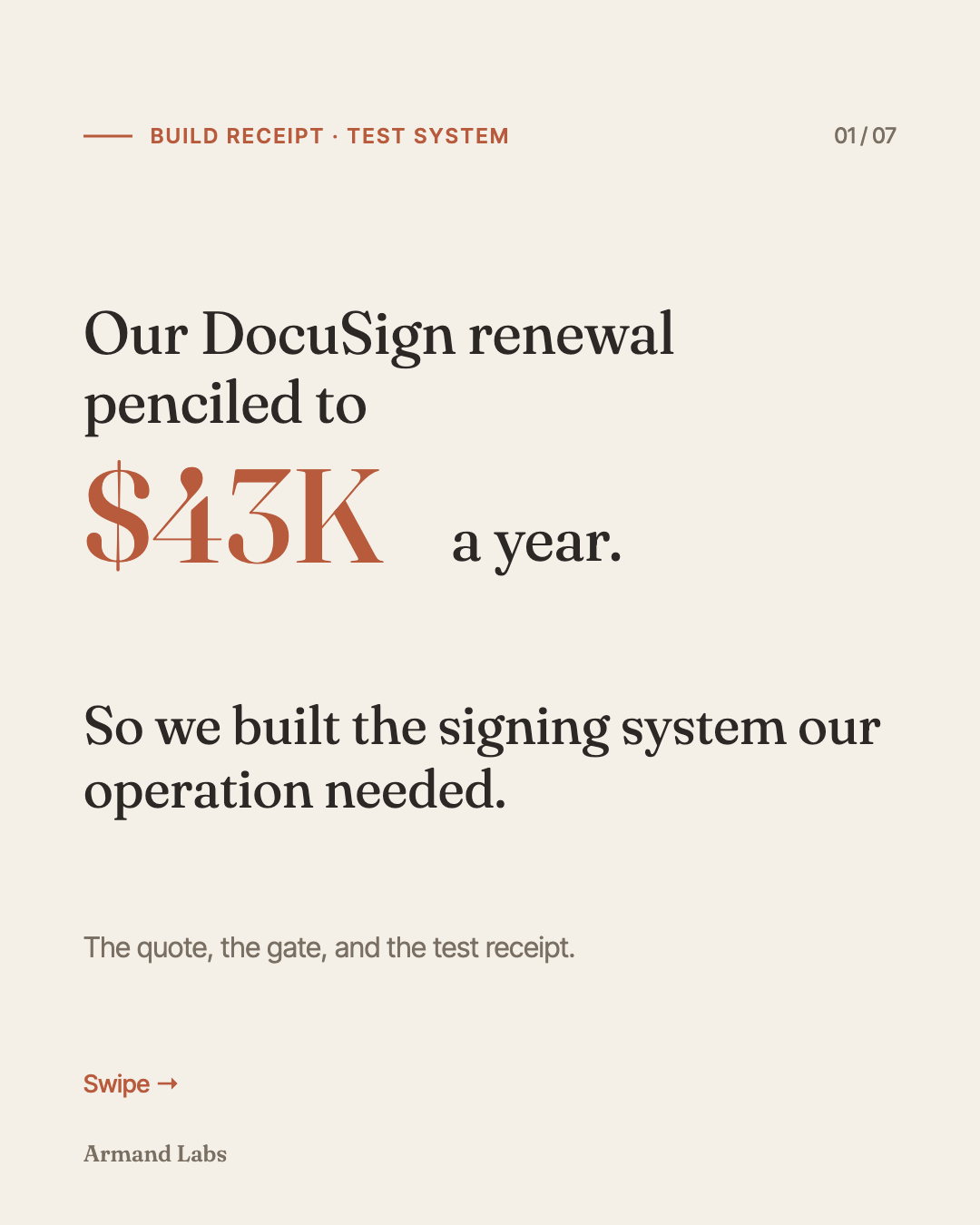
I opened two DocuSign renewal offers. Both put $25,096.50 on the page. That looked like the annual number. It wasn't.
We had sent 3,787 envelopes in 11 months — roughly 4,100 a year at that pace. One offer included 1,500 sends, then charged $6.90 for every send over the limit. That put another roughly $18,000 on top. The alternate 2,000-send option still penciled to about $39,800.
The bill exposed the wrong problem
The obvious reaction was to shop for a cheaper signature tool. But the signature itself was only one stop in the operation.
A contract started as a PDF in our event system. Before anyone could sign it, every field had to be present and in the right place. After signing, the final PDF had to be sealed, the signing history had to become an audit certificate, both records had to be filed, and the finished copy had to reach the client. The expensive product handled the middle. Our team still owned the handoffs.
That changed the assignment. We did not need another place to draw a signature. We needed one chain of custody from contract creation to delivery.
So we built the whole chain
The new system takes the contract, detects the required fields, and refuses to send a malformed document. It creates the signing session, records what happened, seals the finished PDF, generates the certificate, files the records in SharePoint, and emails the signed copy.
That refusal step matters more than the signature screen. A polished signing experience is worthless if the wrong person gets the document, a required field is missing, or a box lands in the wrong place. The quality gate had to catch the problem before the client ever saw it.
Then we tried to break it
We created 36 deliberately broken test contracts. A naive validator reported nine bad documents as fine. The new gate caught all 36.
Naive check
Nine bad files escaped.
New gate
Every bad file was stopped.
That is the difference between a feature and an operating system. The feature lets a person sign. The system makes sure the right document gets signed, preserves the record, puts it where the business needs it, and finishes the client handoff.
The end-to-end receipt
In one full test, the contract completed 14 fields and captured two drawn marks. The system sealed the signed PDF, generated the audit certificate, filed the records, and delivered the client copy.
The entire post-signature handoff took 51 seconds. More important, nobody had to remember the next step or move the same contract between three systems by hand.
Most software stops at the signature.
Ours finishes the job.
Built with Next.js, Supabase, Microsoft 365, and SharePoint.